
Back in August of 2024, we were contacted by Charles Angel about using Workflowy to help his youth robotics teams manage their projects. After a couple of back and forth emails and learning more about the amazing things his students were doing and the success they’ve been having – we decided to feature them on the blog and tell their story. In upcoming posts we’ll share the details of how they’re using Workflowy to manage their team and the competition, but for this first entry we wanted to simply introduce you to them and the exciting work they’re doing.
In the heart of rural South Carolina, a robotics team is defying expectations and proving that innovation knows no boundaries. The Due Westerners, hailing from a town of just 1,200 people, are making waves in the competitive world of FIRST Robotics, outperforming teams from much larger and better-funded schools.
The story of Due West Robotics began in 2012 when Charles Angel, inspired by his son’s LEGO Mindstorms kit, formed the first FIRST Lego League team. What started as a family project quickly grew into a thriving nonprofit organization, becoming what’s now considered “the benchmark for rural youth robotics programs”. This grassroots beginning highlights the power of community-driven initiatives and demonstrates how even the smallest towns can become hubs of technological innovation and learning when passionate individuals take the lead.
Beyond Gears and Circuits: Nurturing Well-Rounded Innovators
While the robots may be the star attraction, the Due Westerners program is about so much more. As Charles Angel puts it, “The idea is the robot is kind of the hook to get these students interested and excited about stuff, but they’re making business plans, they’re tracking their financials, they’re basically running a small business.”
One of the key differences that sets Due West Robotics apart is their comprehensive approach to student development. The team operates as a small business, managing an annual budget of $50,000-$75,000, with students taking on roles far beyond engineering. Team captain Eli, a homeschooled senior, leads the technical aspects. Sydney, an 11th grader from Emerald High School, manages social media. Kaylee, a sophomore from Dixie High School, oversees awards and outreach.
Sydney, the social media leader, shares her vision: “We’re trying to do videos, more things on YouTube, edits, more layouts, just really trying to expand [our social media presence].” This focus on communication and outreach is crucial for building support and inspiring other young people to get involved in STEM.
This diverse team composition is intentional. Charles explains, “It’s just very much a community group where students from any of the schools from the surrounding areas can be a part of, which is one of the things that we love”. This inclusive approach allows students from different educational backgrounds to come together, fostering a rich collaborative environment.
This Year’s Robotics Challenge
As the Due West Robotics team prepares for their 2025 competition season, they face an exciting and complex challenge set by FIRST (For Inspiration and Recognition of Science and Technology) Robotics. FIRST Robotics Competition is a global robotics program that challenges high school students to design, build, and program industrial-size robots to play a difficult field game in alliance with other teams.
This year’s game, focusing on coral reef conservation, involves coral placement and algae ball manipulation. The competition field, roughly two-thirds the size of a basketball court, is set up to simulate an underwater environment. Teams must design robots capable of picking up and placing “coral” on a multi-level “reef” structure, manipulate large “algae balls”, and navigate the field autonomously for the first 15 seconds of each match – quite the challenge.
Here’s a video explaining the details of this year’s challenge.
Cutting-Edge Innovation in a Small-Town Setting
The Due Westerners’ latest robot showcases sophisticated engineering to meet these challenges. It features an advanced “swerve drive” system that allows for fluid, multi-directional movement. Charles Angel, the team’s president and lead mentor, explains the complexity: “Every single wheel has two motors – one powers the wheel to make it go, and the other motor spins the wheel.” This drive system represents a significant advancement from their previous designs, allowing for unprecedented maneuverability on the competition field.

To handle the coral placement, the robot is equipped with an elevator system that can extend up to about six feet high, allowing it to reach the various levels of the reef structure. The team has also developed a specialized gripper mechanism to securely grasp and release the coral pieces.
The team’s technical prowess extends beyond mechanical engineering. They utilize professional-grade tools and techniques, including using JAVA for the machine learning and vision detection, 3D CAD software for designing their entire robot, and utilizing professional fabrication techniques for their robot’s custom parts.
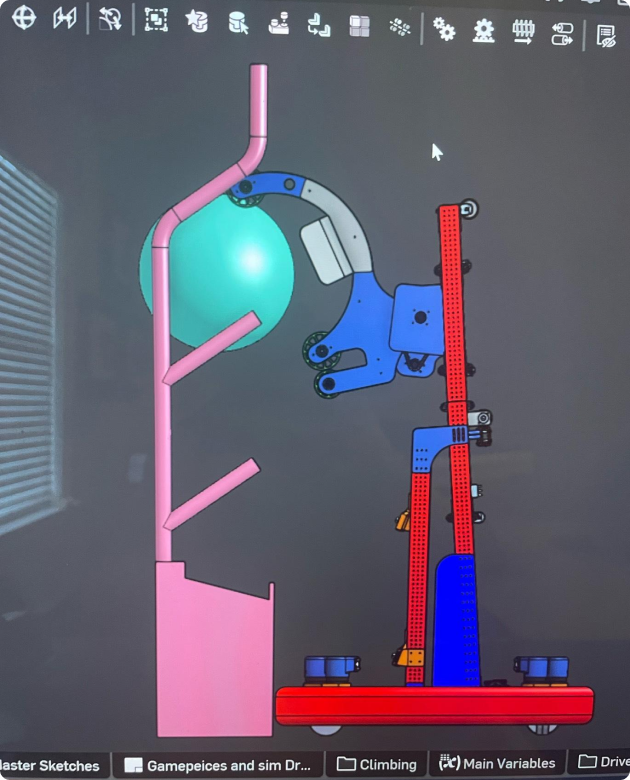
One of the most innovative aspects of their design is the implementation of their vision system using multiple cameras. This system, coupled with machine learning algorithms, allows the robot to identify and locate AprilTags (similar to QR codes) placed around the field. This feature is crucial for both the autonomous period and for assisting drivers during the teleoperated phase of the match.
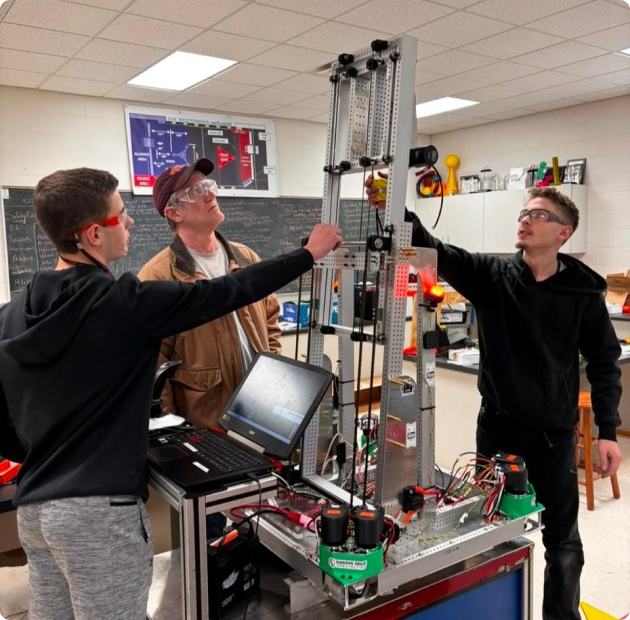
Team captain Eli emphasizes the unpredictable nature of the competition: “The worst part is most of the challenges that we have, especially with the robot, are ones that we don’t see coming. It’s usually ones that kind of just show up during a competition.” This unpredictability requires the team to be adaptable, quick-thinking, and well-prepared for any scenario that might arise during the heat of competition.

As the Due Westerners fine-tune their robot and strategies for the upcoming district and state championships, they’re not just aiming to win – they’re pushing the boundaries of what’s possible in high school robotics, showcasing the innovative spirit of rural America.
The Road to Victory
As the Due Westerners prepare for their upcoming competitions, their goals are ambitious. They’re aiming to be alliance captains, a position reserved for the top-performing teams. But regardless of the competition results, it’s clear that these students are already winners.
They’re breaking stereotypes, pushing boundaries, and proving that with passion, dedication, and community support, rural students can compete with—and often surpass—their urban counterparts in the world of high-tech robotics.
The Due Westerners’ impact extends far beyond their own team. They’re actively working to inspire and educate younger students about the possibilities in STEM. Kaylee, who leads the team’s outreach efforts, explains their approach: “I feel like it’d be better to actually go out to those schools and teach the kids about STEM directly and what FIRST is and kind of push them in the direction of FLL (First Lego League) or FTC (First Tech Challenge) or FRC (First Robotics Competition) because I feel like that is what can help bring STEM into the community.”
This commitment to community outreach and education is a cornerstone of the Due Westerners’ mission. By sharing their passion and knowledge, they’re not just building robots – they’re building a pipeline of future innovators and problem-solvers in their rural community.
We’ll be checking in with The Due Westerners periodically to share their updates and their journey as they aim for robotics supremacy this 2025, so be sure to check in regularly to the blog. We’ll also share how they’re using Workflowy to stay organized and on top of the competition.
Thanks to everyone on The Due Westerners team for taking the time to speak with me and share their experience. To follow them directly, donate, or watch their matches – you’ll find links to everything at duewesterners.org
Something tells me that their system is going to involve bullet mirrors. I can feel it.
Genial !!!! Mis hijas mañana estarán felices de leer esto. Es inspirador
Gracias por compartir y difundir